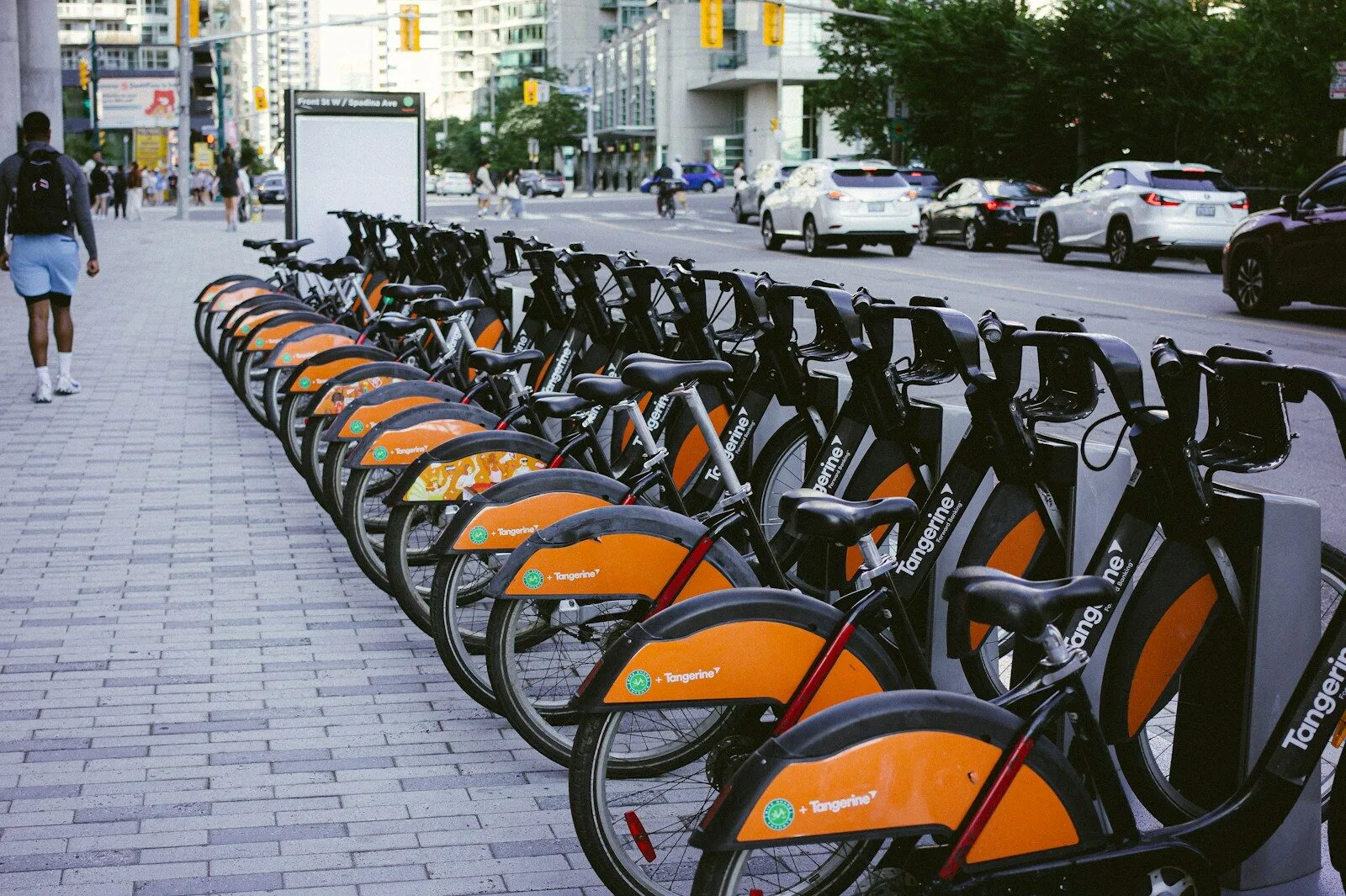
Toronto Police recorded 2,121 bicycle thefts across the city’s 158 neighbourhoods in 2025, a rate of 66 per 100,000 residents and 22% fewer than in 2024. That is the lowest annual total since the series began in 2014 and 47% below the 2018 peak of 3,967, according to Toronto Police Service open data (our calculation). 99 of 158 neighbourhoods recorded fewer bike thefts than a year earlier.
Data: Toronto Police Service, Neighbourhood Crime Rates Open Data (2014–2025, last updated 2 February 2026) and Bicycle Thefts Open Data (occurrences to 30 September 2026, last updated 8 October 2026). Totals, rates, shares and rankings are our own calculation. Updated 22 October 2026.
Key facts
- Toronto recorded 2,121 bicycle thefts in 2025, down from 2,712 in 2024 (−22%) and 3,967 in 2018 (−47%), in Toronto Police Service neighbourhood data (our calculation).
- The city-wide bike theft rate was 66 per 100,000 residents in 2025, based on a neighbourhood population of 3,214,722 (our calculation).
- 11 of 158 neighbourhoods recorded no bicycle thefts at all in 2025, and 114 had a rate below the city-wide 66.
- From January to September 2026, Toronto Police data show 1,527 bike thefts, 13% fewer than the 1,760 in the same months of 2025 (our calculation).
- 54% of 2025 bike thefts happened between June and September; August alone had 322 (our calculation from Toronto Police occurrence data).
- Apartment buildings (25%) and outdoor locations (25%) were the most common places where bikes were stolen in 2025, followed by commercial premises (21%).
How many bikes are stolen in Toronto each year?
Toronto Police Service data show 2,121 bicycle thefts in the city of Toronto in 2025, or about 6 a day on average (our arithmetic). The total has fallen in four of the last five years and is now 30% below the 2014 level of 3,021.
Bicycle theft, in Toronto Police open data, is any reported occurrence in which a bicycle was stolen, whether the main offence was theft, break and enter or another crime. Reports that police deemed unfounded are excluded. Because many owners never report a stolen bike, these numbers are a floor, not a full count: Statistics Canada’s 2019 victimization survey found that only about 29% of all victimizations in Canada were reported to police.
| Year | Bike thefts in Toronto (count) | Change vs previous year |
|---|---|---|
| 2014 | 3,021 | — |
| 2015 | 3,292 | +9% |
| 2016 | 3,797 | +15% |
| 2017 | 3,853 | +1% |
| 2018 | 3,967 | +3% |
| 2019 | 3,702 | −7% |
| 2020 | 3,915 | +6% |
| 2021 | 3,156 | −19% |
| 2022 | 2,940 | −7% |
| 2023 | 3,014 | +3% |
| 2024 | 2,712 | −10% |
| 2025 | 2,121 | −22% |
Sum of all 158 neighbourhoods, Toronto Police Service Neighbourhood Crime Rates Open Data; changes are our calculation. Contains information licensed under the Open Government Licence – Ontario.
The 2025 fall of 22% (591 fewer thefts) was the largest percentage drop in the series; the biggest drop in absolute numbers came in 2021 (−759). For the overall picture across all major crimes, see Toronto crime rate by neighbourhood.
Which Toronto neighbourhoods have the lowest bike theft?
Eleven Toronto neighbourhoods recorded zero bicycle thefts in 2025, including West Rouge, Morningside, Parkwoods-O’Connor Hills and Edenbridge-Humber Valley, according to Toronto Police Service data. Four more had just one theft each, for rates between 3 and 4 per 100,000 residents (our calculation).
| Neighbourhood | Bike thefts (2025) | Bike thefts (2024) | Rate per 100,000 (2025) |
|---|---|---|---|
| West Rouge | 0 | 3 | 0 |
| Eringate-Centennial-West Deane | 0 | 2 | 0 |
| Morningside | 0 | 0 | 0 |
| Edenbridge-Humber Valley | 0 | 2 | 0 |
| Parkwoods-O’Connor Hills | 0 | 4 | 0 |
| Ionview | 0 | 0 | 0 |
| Humber Summit | 0 | 1 | 0 |
| Bridle Path-Sunnybrook-York Mills | 0 | 4 | 0 |
| Maple Leaf | 0 | 1 | 0 |
| Rexdale-Kipling | 0 | 2 | 0 |
| Old East York | 0 | 6 | 0 |
| Woburn North | 1 | 6 | 3 |
| Steeles | 1 | 6 | 4 |
| Kingsview Village-The Westway | 1 | 3 | 4 |
| East L’Amoreaux | 1 | 3 | 4 |
| Toronto, all 158 neighbourhoods | 2,121 | 2,712 | 66 |
Our calculation from Toronto Police Service Neighbourhood Crime Rates Open Data (Open Government Licence – Ontario). Rates use 2025 population estimates; all neighbourhoods listed have at least 10,000 residents.
Low counts are also found closer to the core: Leaside-Bennington recorded 2 bike thefts (11 per 100,000), South Eglinton-Davisville 6 (21) and Danforth 4 (39). For a ranking that combines several crime types, see the safest neighbourhoods in Toronto.
Where in Toronto are the most bikes stolen?
Yonge-Bay Corridor recorded the most bicycle thefts of any Toronto neighbourhood in 2025, with 137, down from 192 in 2024, according to Toronto Police Service data. The next highest counts were St Lawrence-East Bayfront-The Islands (123), Downtown Yonge East (109), Wellington Place (92) and Kensington-Chinatown (89).
The 10 neighbourhoods with the most bike thefts together accounted for 873 thefts, or 41% of the city total (our calculation). Most of them are downtown, where many people commute, study, shop and park bicycles each day. Rates per resident therefore overstate the risk for people who live there, and a high count does not describe a particular residential street. Seven of those ten neighbourhoods still recorded fewer thefts in 2025 than in 2024.
Which neighbourhoods saw the biggest drop in bike theft?
Fort York-Liberty Village had the largest drop in bicycle thefts among Toronto neighbourhoods with at least 40 thefts in 2024, falling 55% from 87 to 39 in 2025 (our calculation from Toronto Police Service data).
- West Queen West: 43 to 19 (−56%)
- Fort York-Liberty Village: 87 to 39 (−55%)
- Dufferin Grove: 48 to 26 (−46%)
- South Riverdale: 51 to 30 (−41%)
- Harbourfront-CityPlace: 76 to 49 (−36%)
- Yonge-Bay Corridor: 192 to 137 (−29%)
Across the city, 99 neighbourhoods recorded fewer bike thefts in 2025 than in 2024, 43 recorded more and 16 were unchanged. 113 neighbourhoods were below their 2018 level (our calculation).
When and where are bikes stolen in Toronto?
Bike theft in Toronto is strongly seasonal: 1,143 of the 2,131 thefts in the 2025 Toronto Police occurrence data, or 54%, happened from June to September, while December to February accounted for 7% (our calculation).
| Place where the bike was stolen | Thefts (2025) | Share of 2025 total |
|---|---|---|
| Apartment (incl. bike rooms and building garages) | 537 | 25% |
| Outside (streets, parks, racks) | 533 | 25% |
| Commercial | 457 | 21% |
| Other | 319 | 15% |
| House | 175 | 8% |
| Educational | 91 | 4% |
| Transit | 19 | 1% |
Our calculation from Toronto Police Service Bicycle Thefts Open Data (Open Government Licence – Ontario), premises type field. This file counts 2,131 thefts in 2025, slightly more than the 2,121 in the neighbourhood file, because the two datasets are compiled separately.
About a third of 2025 thefts happened at a home (apartment or house), so a locked bike room or garage is not a guarantee. Only 8 of the 2,131 bikes stolen in 2025 were listed as recovered in the data (0.4%), although the status field may not capture every bike returned later.
Is bike theft going down in Toronto in 2026?
Bicycle theft in Toronto was down 13% in the first nine months of 2026, with 1,527 thefts from January to September compared with 1,760 in the same period of 2025, according to Toronto Police Service occurrence data (our calculation). The busiest month so far in 2026 was June, with 291 thefts. These figures are preliminary and may change as reports are reviewed. The same pattern of decline shows up in Toronto car theft by neighbourhood, while the Toronto break-ins by neighbourhood report covers burglaries, including garage and shed break-ins.
How can I protect my bike in Toronto?
- Record your serial number. It is usually stamped under the bottom bracket; keep it with a photo and receipt so police can match a recovered bike.
- Lock the frame to something fixed. Use a solid U-lock through the frame and a wheel, on a rack or post that cannot be lifted over.
- Be careful in summer. More than half of thefts happen from June to September, so do not leave a bike unlocked even for a few minutes.
- Do not rely on the bike room. A quarter of thefts happen at apartment buildings; lock the bike inside shared storage too.
- Report every theft. A police report adds the bike to the official data and, with a serial number, helps if it is found.
- Check your area. The Toronto Police Public Safety Data Portal has bicycle theft maps and data; see also our Toronto crime map and how to check crime in your neighbourhood.
Students cycling to class can also use the walk and escort programs listed in our campus safety in Canada guide. For the wider question of personal safety, read is Toronto safe.
Want this on your phone?
Safety App Canada puts official crime data on a live map, plans walking routes that avoid high-risk areas and sends one-tap SOS alerts to the people you trust. Coming soon to Android and iPhone.
Toronto bike theft FAQ
How many bikes are stolen in Toronto?
Toronto Police recorded 2,121 bicycle thefts in 2025, about 6 a day, down 22% from 2,712 in 2024.
Is bike theft going down in Toronto?
Yes. The 2025 total was the lowest since 2014 and 47% below the 2018 peak, and January to September 2026 was 13% below the same months of 2025.
Which Toronto neighbourhood has the least bike theft?
Eleven neighbourhoods, including West Rouge, Morningside and Parkwoods-O’Connor Hills, recorded no bike thefts in 2025, according to Toronto Police data.
Where are the most bikes stolen in Toronto?
Yonge-Bay Corridor recorded the most bike thefts in 2025 (137), followed by St Lawrence-East Bayfront-The Islands (123). Downtown counts reflect large numbers of commuters and visitors, not only residents.
When are bikes most often stolen in Toronto?
Summer. In 2025, 54% of bike thefts happened between June and September, and August was the busiest month with 322.
Related: Toronto crime rate by neighbourhood · safest neighbourhoods in Toronto · Ontario crime map · crime rates in Ontario cities · crime rate in Canada by city · Canada Crime Map. In an emergency call 911.